Everything You Need to Know About Knee Replacement Surgery in Nerul
Tags: #DrSonawaneHospital, #JointReplacementSurgery, #KneeReplacementNaviMumbai, #KneeReplacementNerul, #KneeReplacementSurgery, #NerulHospital, #OrthopaedicCareNaviMumbai, #PainFreeKnees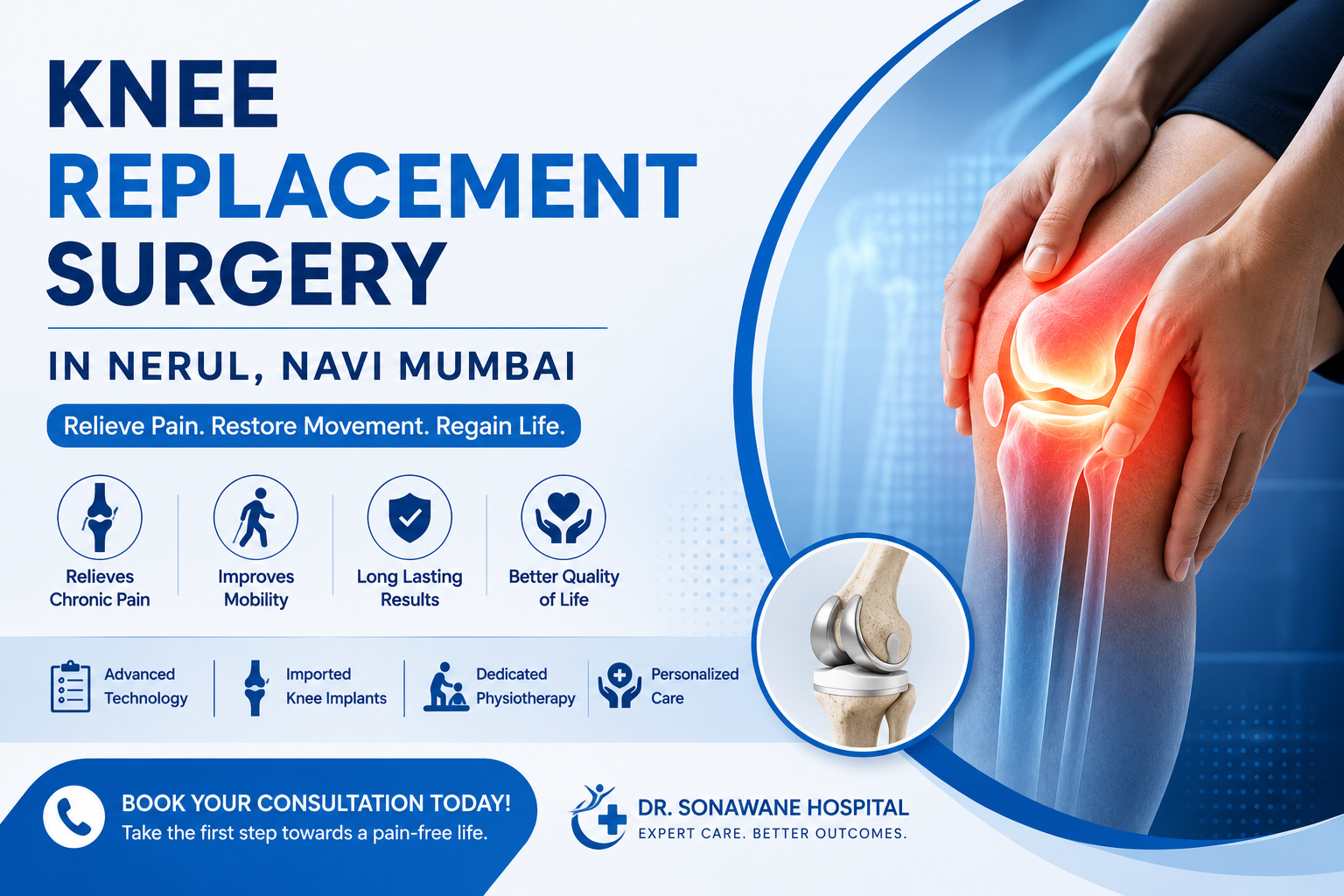
There’s a point where knee pain moves from “annoying” to “life-limiting” — when stairs become a calculation, walks get shorter, and a good night’s sleep feels like a luxury. For patients who’ve already tried medication, physiotherapy, and lifestyle changes without lasting relief, knee replacement surgery in Nerul offers a genuine path back to normal movement, not just pain management.
At Dr. Sonawane Hospital, Dr. Avinash Sonawane brings decades of orthopaedic experience to exactly this problem. Patients across the region choose knee replacement surgery in Navi Mumbai here because the approach isn’t just about the operation itself — it’s about careful diagnosis, precise technique, and a recovery plan built around the individual.
What Actually Happens During Knee Replacement
Knee replacement, or knee arthroplasty, involves removing the worn-out or damaged surfaces of the knee joint and replacing them with artificial implants made from metal alloys and medical-grade plastic. It’s typically recommended once cartilage has broken down enough — through osteoarthritis, rheumatoid arthritis, injury, or general wear — that non-surgical options no longer offer meaningful relief.
The procedure itself usually takes one to two hours. Depending on how much of the joint is affected, the surgical team may recommend a total replacement, a partial replacement that preserves more natural bone, or — in cases where an earlier implant has worn out — a revision procedure. Getting knee replacement surgery in Nerul right starts with figuring out which of these fits the individual case, not applying a one-size-fits-all approach.
Signs You Might Need It
Not every ache calls for surgery, but a few signals are worth acting on:
- Knee pain that limits walking, standing, or climbing stairs
- Pain that persists even while resting
- Stiffness that noticeably restricts movement
- Swelling that doesn’t improve with medication
- X-rays showing advanced joint damage
- Little or no improvement from physiotherapy and other conservative treatment
Conditions like osteoarthritis, rheumatoid arthritis, post-traumatic arthritis, and joint deformity are the most common reasons patients eventually consider knee replacement surgery in Navi Mumbai. If several of these apply, a proper evaluation is worth scheduling sooner rather than later.
What Recovery Actually Looks Like
Recovery timelines vary by patient, but a general pattern holds for most people undergoing the procedure:
- Most patients stand and begin walking with support within 24–48 hours
- A typical hospital stay runs 3–5 days
- Stitches are usually removed around 12–14 days post-surgery
- Return to regular daily activities generally takes 4–6 weeks
- Full recovery, including strength and flexibility, is usually reached within 3–6 months
Physiotherapy plays a major role throughout this window. Muscles need retraining, and joint flexibility doesn’t return on its own — structured rehabilitation is what turns a technically successful surgery into a genuinely functional recovery.
Why the Surgeon and Hospital Choice Matters
Not all knee replacement surgery in Nerul providers offer the same level of care. Outcomes depend heavily on surgical precision, implant quality, infection control standards, and how closely a patient is monitored afterward. High-quality implants can last 15–20 years or more, but that lifespan depends on both the surgical execution and the patient’s own commitment to rehabilitation and weight management afterward.
At Dr. Sonawane Hospital, patients get access to a modern operation theatre, imported knee implants, strict infection protocols, and dedicated post-operative physiotherapy — the combination that tends to separate a smooth recovery from a complicated one. Some patients arrive after prior injuries requiring trauma surgery, where joint damage sustained years earlier eventually progresses to the point of needing replacement.
Knee Replacement Within the Bigger Picture
Knee replacement is one part of a broader category of care known as joint replacement surgery, which also covers other major joints affected by long-term wear or injury. Patients considering knee replacement surgery in Navi Mumbai dealing with joint pain elsewhere in the body — most commonly the hip — often ask about hip replacement surgery alongside their knee consultation, since the underlying causes (arthritis, cartilage loss, prior injury) frequently overlap.
Frequently Asked Questions
How long does the surgery take? Knee replacement surgery typically takes about one to two hours, depending on the complexity of the case and which type of replacement is being performed.
Is knee replacement surgery painful? Modern anaesthesia and pain management protocols keep discomfort well controlled during and immediately after surgery. Some soreness during physiotherapy is normal as the joint regains movement.
How long do knee implants last? With proper care and weight management, high-quality implants typically last 15–20 years or longer before any further intervention is needed.
When can I start walking after surgery? Most patients begin walking with assistance within 24–48 hours of the procedure, as part of the early physiotherapy protocol.
Do I really need physiotherapy afterward? Yes. Physiotherapy is what restores strength and flexibility to the joint — skipping it significantly increases the risk of stiffness and a slower, less complete recovery.
Take the Next Step
If chronic knee pain has been limiting your daily life, waiting rarely makes the decision easier. A proper evaluation for knee replacement surgery in Nerul or knee replacement surgery in Navi Mumbai can clarify exactly what’s happening in the joint and what your realistic options are. Book a consultation with Dr. Avinash Sonawane and take the first step toward walking without pain again.